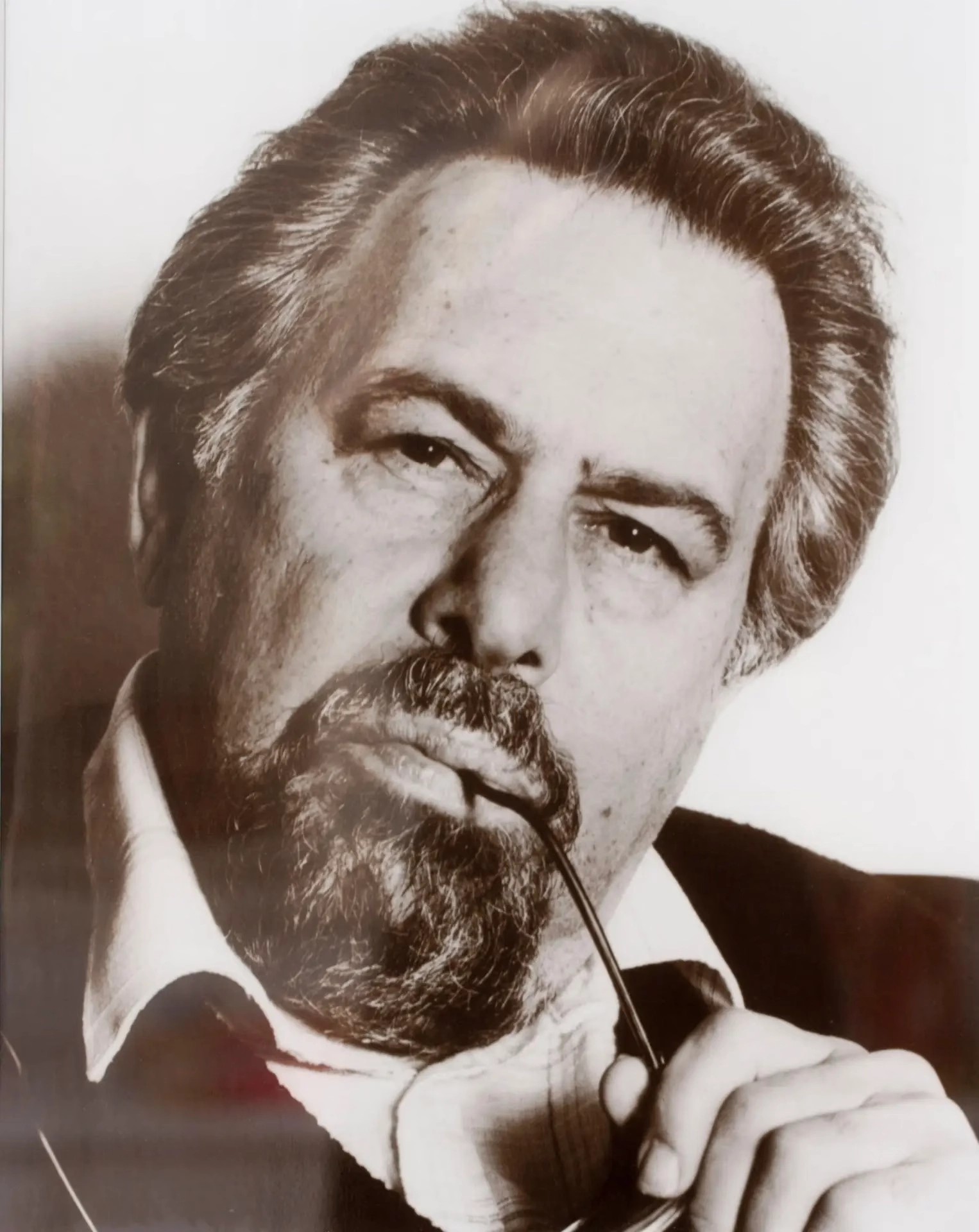
Anyone who was ever taught by Len Del Ferro remembers a passionate and charismatic man with great empathy, an infectious laugh, and an unwavering belief in the potential of every human being.
As an internationally celebrated opera singer, he shared the stage with greats like Maria Callas and performed in the world’s most prestigious opera houses, from Covent Garden in London to La Scala in Milan.
Yet his greatest passion did not lie on the stage, but in helping people who stuttered. Len discovered that the key to fluent speech lay in mastering breathing and the diaphragm muscle. With that insight, he developed the Del Ferro method and gave thousands of people the opportunity to learn to speak freely and fluently again.
A Colorful Personality with an Analytical Mind
In the 1960s, American-born Len Del Ferro settled in Amsterdam. He fell instantly in love not only with the city, but also with a young woman in a radiant white dress on the terrace of the American Hotel.
“That’s her. That’s going to be my wife,” he resolutely told his dining companions.
He was right. José became his great love and stood unconditionally by his side for the rest of his life.
Anyone who met Len didn’t forget him easily. He was a flamboyant personality with a big heart, an infectious laugh, and a unique sense of humor. For instance, he might suddenly sing an aria for the cashier in the middle of the supermarket, simply to make someone laugh.
Singer René Froger still remembers him well:
“Len was a flamboyant man who regularly visited Bolle Jan, my father’s pub. It often happened that he would spontaneously start singing loudly there. He had a big heart, but he could also be extremely strict if you strained your voice.”
Behind that colorful and exuberant personality, however, lay a sharp, curious, and analytical mind. Len did not settle for existing explanations. He wanted to understand how the human body truly functioned and what lay behind human behavior. He kept asking questions, making connections, and searching for answers that went beyond what was generally accepted.
Physical therapist Michael Davidson remembers how Len once walked into his practice with back problems. Before the conversation had even properly begun, he said:
“You stutter. And do you know why?”
Len explained how breathing and the diaphragm play a crucial role during speech.
“For me, it was as if the scales fell from my eyes,” Davidson says. “No one had ever explained to me what I was doing mechanically wrong while talking.”
That curiosity, combined with his profound knowledge of the voice, breathing, and the human body, formed the basis for the discovery that a few years later would grow into the Del Ferro method.
His steadfast life motto, which he passed on to his students as well as his daughter Ingrid, was as simple as it was inspiring:
The sky is the limit.
The Breakthrough in 1978
The foundation for the proven Del Ferro Method originated by chance in 1978. A German tenor visited Len in Amsterdam to refine his singing technique. In daily life, however, he stuttered severely. The paradox was fascinating: while singing, even the most difficult arias flowed effortlessly from his mouth, whereas during speech he could block completely.
For Len, this was an important insight. How could someone be completely stutter-free while singing, yet stutter severely while speaking? It showed him that the speech organs were capable of functioning fluently.
Len knew that good control of the diaphragm muscle forms the basis for a powerful and controlled singing voice. He instructed the tenor in his specific breathing technique. When the tenor applied this technique to speaking as well, something remarkable happened: he spoke completely stutter-free.
For Len, this marked the beginning of a new perspective on stuttering. He saw a direct link between controlling the diaphragm muscle and speech fluency. From that discovery, he developed the foundation of the method that would later become known as the Del Ferro Method.
From hypothesis to scientific research
Strengthened by this finding, Len wanted to understand exactly what happened in the body of someone who stutters. Refusing to settle for existing explanations, he set out to find a physical explanation for the striking difference between speaking and singing.
His hypothesis also caught the attention of neurologist Dr. J.C.J. van Hemert. He was the first to set up a scientific study into Len’s hypothesis and used X-ray fluoroscopy to investigate what happened inside the body during speech. This revealed that the diaphragm makes uncontrolled movements in people who stutter.
His very first student, pianist Peter Kranen, later regularly accompanied Len during singing rehearsals. “The method worked extremely well, and to this day I benefit from it,” says Kranen. Decades later, he still experiences the advantages of his training. By targeted training of the diaphragm muscle, students can speak stutter-free from the very first day of the course.
What Len discovered in 1978, we continue to investigate today using modern measurement methods. We closely monitor our students’ development and systematically track their progress in speech fluency.
The Stutterer: An Ode to Speech Freedom
How deeply this physical and mental victory impacts a human life was beautifully expressed by alumnus Peter Hovestadt in his poem – originally written in Dutch and translated closely to the original text – written especially for Len and the Del Ferro Method:
I speak my words with halting hesitation,
And offer then a forced and guarded smile,
With anxious care, they look away and avoid my gaze,
And when a word escapes, the next brings trepidation—
A trembling moment, feared for endless days;
Will they laugh at me, or watch in cold amaze?
Thus I live on in constant fear and dread,
Growing ever quieter in all I do,
No speech therapist can cure me, it was said,
“You’ll just have to live with it,” they told me then.
Yet deep within, that hope would still remain
That one day I could captivate a crowded hall,
My deepest dream, untouched by time or pain,
For breathless, they will listen to it all…
Then a friend points the way to Amsterdam,
And I learn to let my diaphragm guide my speech,
After a few months, the joy of victory came,
A certain confidence that freedom is within reach.
Del Ferro knew the secrets of the ancient Greeks,
He put them into practice with profound success,
Taking the winged word on golden wings,
… born from a diaphragm entirely free of stress.
My dream fulfilled, and no one ever knows
That once my speech was halting, trapped, and slow,
And if one day I too forget those woes,
The seal upon my lips is broken, free to flow!
Now here I stand before a crowded space,
My fluent words reach every listening ear,
With liberated breath, I find my place,
No mockery from those who gather near.
A Legacy of Absolute Dedication
Len’s genius reached far beyond the world of singing. During one of Dr. Van Hemert’s studies, it came to light that Len’s insights might be applicable much more broadly than just for stuttering. Research was conducted into conditions such as hyperventilation and exercise-induced asthma, as well as the potential role of breathing in fitness, endurance, recovery, and focus.
These new insights subsequently led Len into other fields. Elite sports also proved to be a fascinating new arena. Cycling team manager Peter Post and Ajax manager Johan Cruyff asked Len to apply his knowledge and breathing technique within elite sports. Len dived in with enthusiasm, exploring in practice what his method could offer athletes.
The experience Len gained there aligned with his continuous quest to explore the possibilities of breathing and the diaphragm. It showed him that his method could have interesting applications not only within stuttering therapy, but in other areas as well.
When a journalist once skeptically asked him whether stuttering therapy wasn’t a step backward after his successful opera career, his answer was telling:
“I had a fantastic singing career and enjoyed it immensely. But success on stage is fleeting. When I hear a child who could never get their words out suddenly speak fluently because of my method, that gives me an intensely deep satisfaction. Deeper than any standing ovation.”
Len did not believe in resignation as an endpoint. Where people who stutter were long taught primarily to accept their stutter and learn to live with it, Len wanted to explore whether it was possible to overcome it entirely. To him, stuttering was not a limitation to which someone had to resign themselves, but a problem that could be completely resolved.
On May 16, 1992, Len Del Ferro passed away due to a pulmonary embolism. Yet today, his life’s work breathes more powerfully than ever before. He refused to accept chronic limitations and taught the world to conquer stuttering once and for all. His unique insight lives on in every student who takes the floor with absolute confidence for the very first time.
 Skip to content